A Comprehensive Guide to Building Granny Flats (Small Second Dwelling) in Victoria
Thinking about building a granny flat in Victoria? Recent planning changes have made it easier for many homeowners to build a small second dwelling on their property, but there are still important rules, permit requirements, and building standards to understand before construction begins.
In Victoria, a granny flat is officially known as a small second dwelling. These self-contained dwellings can provide:
- accommodation for family members,
- rental income opportunities,
- flexible work-from-home or guest space,
- or long-term property value.
This guide explains the current small second dwelling rules in Victoria, including:
- whether a planning permit is required,
- when a building permit is needed,
- size and zoning requirements,
- siting and setback rules,
- and common mistakes to avoid.
The information below incorporates guidance from the Victorian Government's Making it Easier to Build Small Second Dwellings - Applicant's Guide published by the Department of Transport and Planning (December 2023).
Definition of a Small Second Dwelling
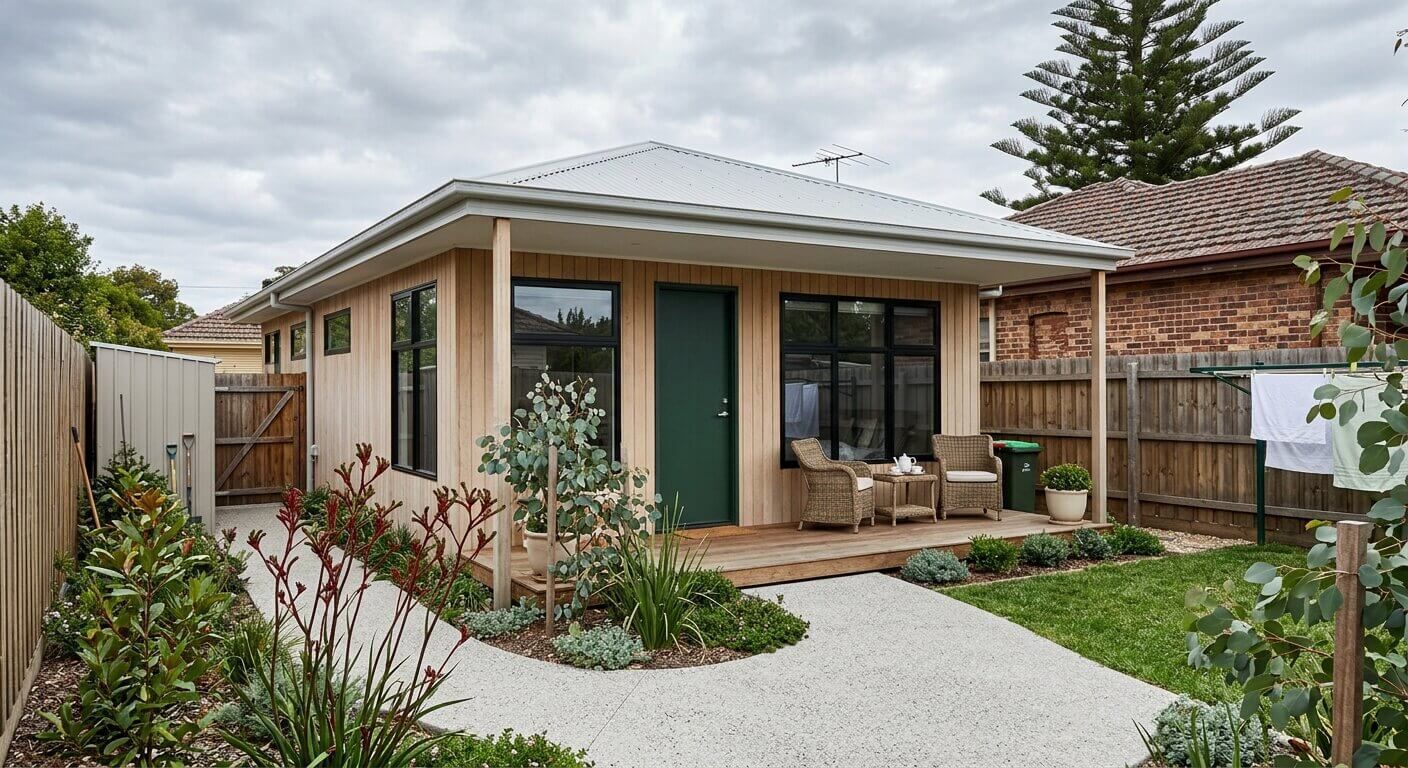
A “Small Second Dwelling” is the term used to describe a residence that measures 60 square meters or less and includes essential amenities such as a kitchen, bathroom, and toilet. This dwelling must be situated on the same property as another existing home.
Do Granny Flats Need a Building Permit in Victoria?
Yes. A building permit is always required for a granny flat (small second dwelling) in Victoria.
A building permit confirms that the proposed building complies with:
- the Victorian Building Regulations 2018,
- the National Construction Code (NCC) 2025,
- structural safety requirements,
- energy efficiency standards,
- and health and amenity provisions.
The Victorian Government states:
“A building permit is always required for a small second dwelling.”
Even where a planning permit is not required, a building permit must still be obtained before construction begins.
NCC 2025 has applied in Victoria since 1 May 2026, so new applications are assessed against that edition. Where the design of a project was substantially progressed before that date, a building surveyor may still assess it under the previous edition (NCC 2022).
What Is a Small Second Dwelling?
A small second dwelling is a self-contained home located on the same lot as an existing dwelling. Under the Building Regulations 2018 it is a Class 1a building, the same classification as a house.
Under Victorian rules, a small second dwelling must:
- be 60m² or less in gross floor area,
- include a kitchen sink and food preparation facilities,
- contain a bath or shower,
- include a toilet and wash basin,
- and be located on a lot that already contains a single existing house, which cannot itself be a small second dwelling.
The dwelling cannot be subdivided onto its own title.
Can You Build a Granny Flat Without a Planning Permit in Victoria?
In many cases, yes.
Recent Victorian planning reforms mean many small second dwellings no longer require a planning permit, depending on:
the zoning of the land,
- lot size,
- overlays,
- and local planning controls.
However, exemptions are not automatic.
The Department of Transport and Planning recommends property owners always check:
- the local planning scheme,
- overlays,
- and council-specific controls before proceeding.
Small Second Dwelling Planning Permit Rules in Victoria
Residential Zones
A planning permit is generally not required in:
- General Residential Zone (GRZ),
- Neighbourhood Residential Zone (NRZ),
- Residential Growth Zone (RGZ),
- Mixed Use Zone (MUZ),
- Township Zone (TZ),
unless the lot is less than 300m².
Where a planning permit is required (for example, on a lot under 300m² in a residential zone other than the Low Density Residential Zone), the Clause 54 residential development standards apply as part of that assessment. Those standards were updated by Amendment VC282, which took effect on 8 September 2025.
Low Density Residential Zone
No planning permit is generally required in the:
- Low Density Residential Zone (LDRZ).
Rural Zones
In:
- Rural Living Zone,
- Farming Zone,
- Rural Activity Zone,
a planning permit may still be required for:
- earthworks,
- setback issues,
- or other zone-specific controls.
Green Wedge and Rural Conservation Land
A planning permit is always required in:
- Green Wedge Zone,
- Green Wedge A Zone,
- Rural Conservation Zone.
Overlays and Other Restrictions
Even where a planning permit exemption applies, overlays and land restrictions may still affect development.
These may include:
- Heritage Overlays,
- Design and Development Overlays,
- Neighbourhood Character Overlays,
- easements,
- restrictive covenants,
- or Section 173 Agreements.
For example:
- a Heritage Overlay may affect external design or demolition works,
- easements may prevent building in certain areas,
- and restrictive covenants may limit development entirely.
Property owners should always obtain site-specific advice before construction.
How the 60m² Limit Is Measured
The 60m² gross floor area includes:
- all roofed areas,
- enclosed living areas,
- and measurements taken from the outside face of external walls or the centreline of shared walls.
This often surprises homeowners who only calculate internal living space.
Can a Garage or Tiny Home Become a Small Second Dwelling?
Yes, in some cases.
The Victorian Government confirms that:
- garages,
- existing outbuildings,
- and tiny homes
may qualify as lawful small second dwellings if they comply with planning and building requirements.
This includes compliance with:
- building standards,
- siting requirements,
- and utility regulations.
Siting and Setback Requirements
Small second dwellings must comply with siting, design, and amenity requirements under:
- Clause 54 of the planning scheme (where planning permits apply),
- or Part 5 of the Building Regulations 2018.
Requirements may include:
- setbacks from boundaries,
- building height limits,
- overlooking controls,
- overshadowing requirements,
- and private open space considerations.
Building Regulation Requirements Specific to Small Second Dwellings
Beyond the general siting rules, Part 5 of the Building Regulations 2018 sets requirements that apply specifically to small second dwellings:
- the dwelling must be set back behind the front wall of the existing house that faces the street (Regulation 74A),
- it must have private open space of at least 8m², with a minimum dimension of 1.6m and convenient access from a habitable room other than a bedroom (Regulation 86A),
- it must have a clear, all-weather path from the front street, at least 1m wide and with a gradient no steeper than 1 in 14 (Regulation 86B),
- minimum garden area requirements continue to apply to the whole allotment (Regulation 76A).
Where a design cannot meet one of these requirements, the report and consent of the relevant council is needed before a building permit can be issued.
Minimum Garden Area Requirements
If the land is within:
- a Neighbourhood Residential Zone,
- or parts of the General Residential Zone,
minimum garden area requirements may still apply where the relevant zone sets one.
The required garden area is based on the size of the whole allotment, not just the granny flat footprint:
- allotments of 400m² to 500m²: at least 25%,
- allotments over 500m² and up to 650m²: at least 30%,
- allotments over 650m²: at least 35%.
This can affect:
- building footprint,
- siting,
- and overall project feasibility.
Can Granny Flats Be Connected to Gas?
No. The Victorian Government states that small second dwellings cannot be connected to a reticulated natural gas supply.
This forms part of Victoria's transition away from new gas connections in certain residential developments.
Many projects instead use:
- electric hot water systems,
- induction cooking,
- and all-electric appliance designs.
Can You Rent Out a Granny Flat in Victoria?
Yes. Small second dwellings can be:
- rented to tenants,
- used for family accommodation,
- or used as short-term accommodation.
However, residential tenancy laws and minimum rental standards still apply.
This includes requirements relating to:
- smoke alarms,
- room sizes,
- ventilation,
- and occupant safety.
Common Mistakes When Building a Granny Flat
Assuming No Permits Are Required
Many property owners incorrectly assume that because a planning permit may not be required, no approvals are needed.
A building permit is always mandatory.
Ignoring Overlays and Covenants
Heritage overlays, easements, and restrictive covenants can significantly affect development potential.
Exceeding the 60m² Threshold
Going over the floor area limit may:
- trigger additional approvals,
- remove planning exemptions,
- or alter compliance requirements.
Not Checking Utility Requirements
Some zones include additional requirements relating to:
- sewerage,
- electricity,
- water access,
- and servicing infrastructure.
How to Get Approval for a Small Second Dwelling
Step 1: Confirm Planning Controls
Check:
- zoning,
- overlays,
- lot size,
- and restrictions affecting the land.
You can obtain a planning property report through the Victorian planning system or contact your local council.
Step 2: Engage a Registered Building Surveyor
A registered building surveyor assesses compliance with:
- the NCC,
- Victorian Building Regulations,
- and siting requirements.
Step 3: Prepare Plans and Documentation
Plans should include:
- site plans,
- floor plans,
- elevations,
- and specifications.
Step 4: Apply for a Building Permit
The building permit application is reviewed before construction approval is issued.
Step 5: Complete Mandatory Inspections
Mandatory inspections occur during construction to ensure ongoing compliance.
Why Choose Code HQ
Building a compliant granny flat in Victoria involves navigating planning controls, building regulations, siting requirements, and permit approvals.
Code HQ assists homeowners throughout the process by helping coordinate:
- building permit approvals,
- regulatory assessments,
- compliance reviews,
- and mandatory inspections.
Our team works with homeowners, designers, and builders across Victoria to help simplify the approval process and support compliant small second dwelling projects.
Final Thoughts
Victoria's updated small second dwelling rules have made granny flats more accessible for many homeowners, but compliance requirements still apply.
While many small second dwellings under 60m² may not require a planning permit, a building permit is always required and site-specific restrictions can still affect development.
Before starting a project, property owners should:
- confirm local planning controls,
- review overlays and covenants,
- and seek advice from qualified building professionals.
Taking the right steps early can help avoid costly delays, redesigns, and compliance issues later in the process.
Disclaimer
This article is intended for general informational purposes only and should not be relied upon as legal, planning, or building advice. Planning controls, permit requirements, and building regulations may change and vary depending on the property and local council area. Always seek advice from a registered building surveyor, local council, or qualified professional regarding your specific project.